Secondary Curriculum
A broad, ambitious and increasingly personalised education
Maypole School's Secondary Curriculum provides pupils with a broad, ambitious and increasingly personalised education, with a growing focus on independence, qualifications, personal development and preparation for adulthood.
Pupils may join Maypole School at different points throughout Key Stages 3 and 4, while others progress into Secondary from our Primary Department. We recognise that every pupil therefore arrives at each stage with their own educational experiences, strengths, needs and academic starting points.
Our curriculum is designed to respond to this. We want pupils to close gaps in their learning where these exist, while ensuring that those working at or towards age-related expectations continue to be stretched and challenged. Alongside academic progress, we place significant importance on emotional regulation, on positive relationships, on independence skills, and on helping pupils to recognise their individual strengths and future aspirations.
Understanding Each Pupil's Starting Point
When a pupil joins Maypole Secondary, we establish a clear understanding of their academic starting point using our detailed baseline assessments, which have been developed from National Curriculum objectives.
This enables us to identify what pupils already know, where gaps in learning may exist, and what they are ready to learn next.
For pupils progressing internally from Maypole School Primary, existing assessment information and knowledge of the pupil are carried forward, ensuring continuity. For pupils joining us from another setting, baselining enables us to quickly build an accurate picture of their learning needs, and to plan appropriately targeted teaching.
Where pupils are working below age-related expectations, teaching is matched to their academic starting point, while remaining appropriate to their chronological age. Where pupils are working at or towards age-related expectations, we provide appropriate stretch and challenge.
Reading in Secondary
Reading remains a priority throughout the Secondary years.
All pupils are assessed to establish their current reading ability. Where a pupil is identified as being two or more years behind, they receive three targeted individual reading intervention sessions each week, alongside their wider curriculum.
Our aim is to ensure that difficulties with reading do not become a barrier to pupils' wider learning, or to their future opportunities.
Key Stage 3 – Building the Foundations
Pupils in Key Stage 3 will continue to be taught most subjects in their classrooms, by their class teacher. We continue to follow the National Curriculum and the pupils will have access to a broad and balanced curriculum, that is differentiated according to their needs and ability. Pupils will engage in English, Maths, Science, PSHE (including Relationships & Sex education), ICT/Computing, Art and Design, Music, Physical Education, Design and Technology (inclusive of Food Technology), History, Geography, Religious Education, Modern Foreign Languages and Careers Education.
Subjects are taught individually, with Secondary lessons increasing to approximately 40 minutes to support pupils in developing their concentration, independence and readiness for increasingly demanding learning. English and Mathematics are each taught four times / week.
"(At Maypole) ... I met compassionate staff who knew their students, showed no fear, and were warm, confident and encouraging to students."
A visiting Educational Psychologist, Jan 2026
Key Stage 4 – Qualifications and Preparing for the Future
As pupils move into (or join us during) Key Stage 4, their curriculum becomes increasingly focused on appropriate qualifications, individual strengths, future aspirations and preparation for adulthood. Our qualification offer provides different levels of challenge so that pupils can work towards meaningful outcomes, that reflect their academic ability and the most appropriate pathway for them.
English, Maths, PSHE (including Relationships and Sex education), Careers Education and PE will always be included in the timetable; and other subject options include Science, Art & Design, ICT / Computing, Music, Design & Technology, History, Geography, Religious Education, and modern foreign languages.
Pupils in Key Stage 4 will work towards a range of qualifications, including GCSEs and Functional Skills qualifications (from Entry Level through to Level 2).
There will also be Vocational qualifications available, with BTecs in Work Skills, Home Cooking, Applied Science, Animal Care, Physical Education, and Personal Growth and Wellbeing.
Pupils also continue to access PSHE and our Preparing for Adulthood (PfA) Curriculum. Looking ahead we are continuing to develop what we offer, and plan to introduce Gateway Qualifications during 2027, further increasing the pathways available to our pupils.
"All this progress since April? We need to send more children to this school!"
Social Worker of a Maypole pupil, June 2026
Preparing for Adulthood
Academic qualifications are important, but they are only one part of preparing a young person for their future.
Our Preparing for Adulthood Curriculum helps pupils to develop the practical knowledge, independence and wider skills that they will need beyond school.
Alongside this, pupils receive Careers education from Key Stage 3 onwards, to help them to explore different occupations and pathways, to understand their own strengths and interests, and to begin making informed decisions about their future.
As pupils approach the end of their time at Maypole, we support them in considering their next destination. This may include progression onto Maypole's Pathways to Employment programme, or to further education at a College.
"She loves school now, she's upset it's a public holiday Monday. She still has blips, but she recovers from them fast now, because of the quality of staff and care at Maypole."
Parent of a Student on a Pathways to Employment placement, April 2026
Personal Development, Regulation and Relationships
Our nurturing approach is embedded throughout the Secondary years, and is adapted appropriately according to each pupil's age, needs and increasing independence.
Pupils are provided with individual regulation strategies, movement breaks, visual support, Zones of Regulation support and nurture spaces, as appropriate and required.
Social and behavioural development is monitored through termly targets, alongside pupils' annual EHCP outcomes. Increasing emphasis is placed (as appropriate) on independence skills, self-awareness, positive friendships, communication, and developing the skills needed to navigate adult life successfully.
Our therapists work collaboratively with teaching staff, providing specialist input while helping the teaching staff to embed appropriate strategies within everyday classroom practice.
Interests, Talents and Enrichment
We recognise that success at school is not defined solely by academic achievement.
Enrichment therefore forms an important part of our Secondary Curriculum, providing pupils with opportunities to discover interests, develop talents, build confidence and experience success in different environments.
Depending upon individual needs, interest and availability, opportunities may include activities such as sport, gym-based activities, horse riding, boxing, music, cooking, creative activities and wider community experiences.
The Pupil's voice is important, throughout the Secondary years. Pupils are encouraged to express their interests and preferences, and as they approach Key Stage 4, they are increasingly involved in discussions about their options, qualifications and future pathway.
Summary
By the time a young person leaves Maypole, we want them to be equipped to positively contribute to society through their education, employment and social skills.
For some pupils, success will mean achieving GCSEs. For others, it may mean Functional Skills or vocational qualifications, developing greater independence or successfully progressing onto their next educational pathway.
Regardless of when a pupil joins us, or what their starting point is, our approach remains that we need to understand the individual, recognise their potential, provide the right level of challenge, and to support them to achieve as much as they possibly can, in whatever way is right for them.
"Across the school, any pupils who struggle with reading are identified and receive support to catch up. As a result, pupils are reading and using and applying their mathematical knowledge with more confidence and fluency. Pupils are also developing more positive attitudes towards this aspect of their education."
Ofsted Report, Maypole School (Leigham Court), June 2024
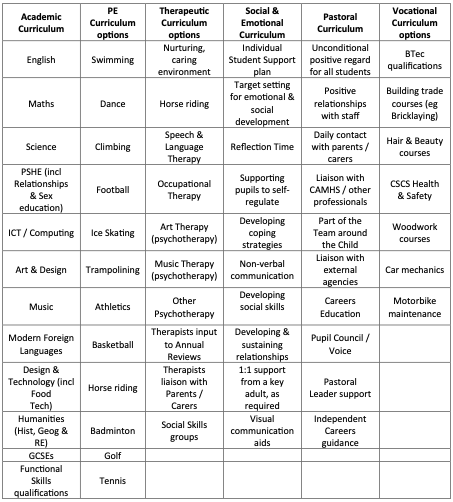
Secondary Curriculum Map
The different components of Maypole’s curriculum for secondary pupils are shown in the table below. This list is not exhaustive; and the availability of some of the non-academic options is dependent on appropriateness, practicality, and on what will best meet each individual pupil’s needs. But everything mentioned below is certainly possible.